
Scene Memorization
Understand that for the first half of the evening, you will be assigned a scene to work on for the following week.
- You will not initially open/hold your script; instead, someone else will be assigned to open it and read their lines twice.
- Pay attention as they read their lines. This exercise involves learning your lines through repetition and association.
- After they’ve read their lines twice they will do your lines 3 times, for approximately one page of the script.
- You will then start performing the scene without looking at your script.
- The aim is to create an associative memory of your lines rather than relying on traditional memorization methods.
The Scene Memorization Exercise
- Begin with simple scenes that have minimal stage directions and involve two characters. Over time, you can add more characters to make it more complex.
- For this exercise, you don’t need to worry about eye lines (where you look during the scene).
- If there are multiple characters in the scene, the reader should read one character’s line, then another character’s line, and so on indicating with hand gestures (i.e. If there were 3 other characters in the scene the reader would pointing left, right and centre. This helps with coordination and understanding the flow of the dialogue.
- Start with roughly a page of the script and practice that section until you’re comfortable.
- Move on to the next page and repeat the process, gradually adding more pages.
- If you’re the reader, announce which character has the first line and help others with clues if needed.
- Allow the participants to rehearse and practice the dialogue in this manner, focusing on creating associations rather than memorizing word-for-word.
- Understand that the goal is not just to recall lines but to understand the relationships, thoughts and emotions within the scene.
Additional Tips:
- Don’t worry if you don’t remember every word in order; focus on understanding the story and character relationships.
- This exercise bypasses the intellect and taps into the associative part of the brain, making it easier to remember lines.
- Remember that our brains are wired to remember stories, so this approach leverages that natural ability.
Questions and Technology:
- If you have questions about the exercise or need further clarification, feel free to ask.
- If you’re concerned about not having a scene partner, try to find someone to practice with, as it’s crucial for the exercise’s effectiveness.
- You can also utilize technology, such as text-to-speech programs or voice assistants, to read lines to you if a scene partner is unavailable. While not ideal, it can still help you practice.
Remember that this exercise may feel challenging at first, but with practice, it can signifcantly improve your ability to memorize lines and connect with your character in a scene.

Saturday

Tuesday

Wednesday
![Promotional poster advertising Advanced/Represented on Camera for ages 16–19, Sunday 2–5 PM EST. A young man sits against a dark backdrop with bold text.]](https://www.lbactingstudio.com/wp-content/uploads/2026/04/LB-Acting-Studio_Advanced-Youth-On-Camera-Young-Adult-Ages-16-19-300x300.png)
Sunday

Thursday

Thursday

Monday

Sunday

Monday
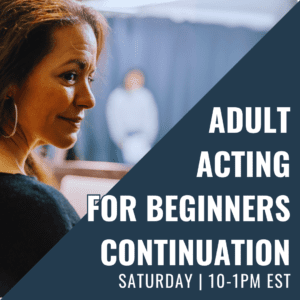
Saturday